Medallitis vs. Health
Being a good runner means thinking about your body and your health. Here is how to prepare —and recover from— a half marathon without getting injured.

Being a good runner means thinking about your body and your health. Are you doing that?
I imagine you've read the news about the Madrid half marathon on 22 March, and if you haven't, here are the numbers.
The most distressing half marathon: 93 runners treated and 8 taken to hospital in Madrid.
More and more of us are running, but we're less and less prepared. We've normalised running 21K. I often hear people say… "well, it's just a half, I can run it no problem even if it's at a slow pace."
Sure, if you have a good base, you have a point, but… are you sure you have a good base?
Don't let medal fever and social media push you into these mistakes.
Preparing for a 21K isn't about weeks on the calendar, it's about giving the body enough time to adapt to impact, fatigue and load. And this, according to SCIENCE, takes somewhere between 10 and 16 weeks. The body needs time to adapt on several levels:
- Cardiovascular system:
It improves relatively quickly, as long as we understand our thresholds and our heart-rate zones. That's why, the moment we consider making the jump to middle and long distance, a stress test should be mandatory.
Here's the best one if you're around Valencia (or want to come and visit us): dr.manudehevia
- Muscles:
They adapt within a few weeks, provided there is prior strength work, but they need progressive loading.
- Tendons / Cartilage:
These are much slower to adapt. They need at least 8–12 weeks to adapt well to repeated impact. You may feel fit in about 4–6 weeks, but your tissues are not.
Has it ever happened to you that you did "seemingly" good preparation, but race day came and injuries appeared? Discomfort around kilometre 15–18… or 24–48 hours after finishing the race. Do you feel identified? It's what usually happens, and it's not that the race injured you, but that the body tends to reveal what wasn't prepared well beforehand, and the longest run, at faster paces, as the race usually is, is the final straw.
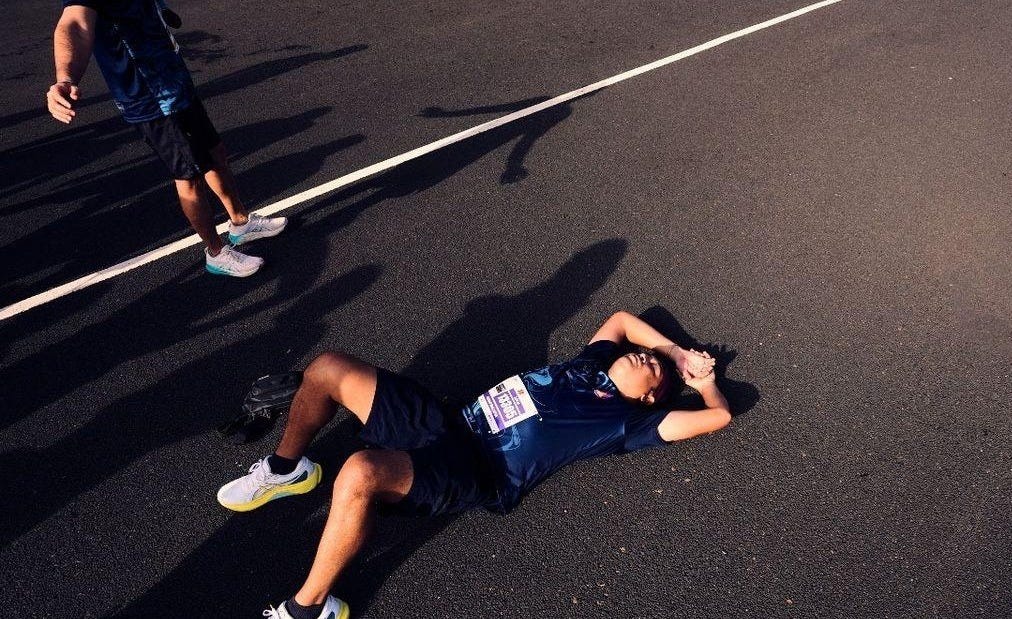
And what happens to the body after running a 21K? Let me tell you:
After a middle-distance race, there are changes in every structure (tendon, bone, cartilage, nervous system and muscle).
- Muscle:
Microscopic fibre tears + inflammation appear. That's why the DOMS eventually arrive, the dreaded soreness along with muscular fatigue. It needs 24–72 hours of recovery.
- Tendon:
There is collagen fatigue. With less load capacity, changes in its stiffness and risk if you go back too soon. It needs a couple of weeks of recovery. If we don't manage it properly, that's where injury appears.
- Cartilage and joint:
A temporary loss of hydration and changes in joint load appear. It recovers but needs management.
- Nervous system:
Central fatigue appears. There's less coordination, poorer motor control and a heavy, slow feeling in the body.
Maybe you can feel that you're ready to go back, but you always have to do things right. And how should you return to avoid injuries? Here's the same advice I always give my patients, so you pamper your body:
- Good nutrition.
- Joint mobility 24 hours later and throughout the week.
- Easy runs for 7–10 days.
- At 12–15 days, start adding more demanding sessions. Intervals / tempo changes.
- Return to competition at 3–4 weeks.
If you listen to your body, you have the perfect signals to compete again:
- No pain when running
- No morning stiffness.
- Good control in strength exercises
- Tolerating loads several days in a row.
YOU DON'T NEED TO RUN MORE, YOU NEED TO RECOVER BETTER.
Despite all this, we're not 100% free from injuries, because we're "humanoids" with our jobs, worries, stress, few hours of sleep, room-for-improvement diets… but let's try to do everything in our power to reduce the risk.
Strength work
Progressive loading
Rest, hydration and nutrition.
By trying to control all of this, we'll manage to add up many kilometres over maaaany years.
What challenges and races do you have this year? Remember everything you've read above, and if you have any questions, write to me — I read you on social media aroafisiofimed. At Clínica FIMED we help you and cross that finish line together, if you need us!!
Before I finish, I'd like to leave here a few things you might find interesting that I've been reading, watching or collecting this week. I found them interesting.
- Podcast: La Fórmula del Éxito with Uri Sabat. The episode with Alex González: The 60-minute habit that changed Alex González's life, kept me company during my 8K yesterday.
- Nutritional strategy for a 21K. You can find it on the social media of Nuria García, FIMED's nutritionist: @nga.nutricion
- ONLINE workshops: Menstrual pain on 11 April / Workshop on Nutrition for a cycling race on 12 April.
- If you'd like information, write to us at: clinicafimed@gmail.com and we'll send it to you
- Everyday top: I always recommend them for daily wear so we forget the typical underwired, clasped bras that compress our ribs and won't let us breathe: TOP LASER CUT, available in 3 different colours and on offer!
- Documentary: Craviotto (2025). The life of Saúl Craviotto, the most decorated Spanish Olympic canoeist. You can find it on Movistar+
"It's not just how much you train, but how you recover. That's where improvement really happens."
Thank you for taking a little while to read me and learn with me.
Oh, and if you have any suggestions for the next newsletter, tell me and let's talk about it.
Happy week and happy Easter break. And if you can't enjoy it, at least ease off the pace and do something that recharges your batteries.
Aroa Olivares